
Fog Computing in Smart City IoT Architectures for Latency Reduction
Abstract
In the context of rapidly urbanizing environments, smart cities increasingly rely on the Internet of Things (IoT) to enhance operational efficiency and improve the quality of life for residents. However, high latency in data processing poses significant challenges for critical applications such as traffic management, public safety, and environmental monitoring. This paper addresses the pressing need for latency reduction in smart city IoT architectures by implementing fog computing. Fog computing extends cloud services to the network's edge, enabling localized data processing closer to the source. This study employs a multi-layered fog architecture that leverages distributed fog nodes to analyze and process data in real time. By integrating edge devices with advanced analytics capabilities, the system minimizes the volume of data sent to centralized cloud services, effectively reducing transmission delays. The results demonstrate a marked improvement in response times across various smart city applications, with latency reductions averaging 40% compared to traditional cloud-centric models. Specifically, traffic management systems exhibited enhanced real-time decision-making capabilities, while public safety applications benefited from faster emergency response times. These findings highlight the potential of fog computing to transform smart city infrastructures by enabling faster data processing and more efficient resource utilization. The implications of this research underscore the importance of adopting fog computing strategies to create resilient, responsive urban environments that can better meet the needs of their inhabitants. As cities continue to evolve, integrating fog computing into IoT frameworks will be essential for realizing the full potential of smart city technologies.
Keywords:Cloud-centric modelsLatencyFog computing
1. Introduction
In the era of rapid urbanization, smart cities have emerged as a transformative approach to managing urban infrastructure through the Internet of Things (IoT) [1]. These cities integrate various connected devices to enhance service delivery and improve the quality of life for residents. However, a significant challenge in these architectures is the latency associated with data processing and transmission. High latency can adversely affect critical applications, such as traffic management systems, public safety initiatives, and environmental monitoring [2].
Fog computing has been identified as a viable solution to address these latency issues. By extending cloud computing capabilities to the network's edge, fog computing facilitates localized data processing, significantly reducing data travel time to centralized cloud servers. This architecture allows for real-time data analysis and quicker decision-making, which is crucial for the dynamic demands of smart city environments.
This paper aims to investigate the impact of fog computing on reducing latency in smart city IoT architectures. We will analyze various case studies where fog nodes have been implemented to enhance the performance of latency-sensitive applications. The findings will provide insights into the potential benefits of integrating fog computing into urban infrastructures, highlighting its role in optimizing resource utilization and enhancing responsiveness.
Ultimately, this research contributes to the ongoing discourse on smart city innovations, underscoring the importance of adopting fog computing strategies to create resilient and efficient urban environments. More precisely, to provide a methodological overview of current studies, we intend to answer several questions that are elaborated upon hereunder:
I. What are the primary motivations behind applying fog computing approaches in smart cities?
II. What existing techniques, approaches, and tasks enable fog computing approaches to be utilized in smart cities?
III. What are the existing tools, evaluation factors, merits, and demerits of studies?
IV. What evaluation methods are applied in fog-based smart cities?
V. What are the prevalent algorithm types applied in fog-based smart cities?
VI. What are the prevailing themes of research studies? More importantly, VII. What pivotal factors should influence subsequent research trends in fog-based smart cities?
we aim to recognize systematically and categorize taxonomically state-of-the-art research available on fog-based smart cities along with providing an abreast comparison to investigate restrictions and potential of existing studies. This strategy supplies a systematic literature review of existing research, concentrating on presented approaches, methods, and solutions in fog-based smart cities. Accordingly, 57 studies are chosen, categorized, and compared, applying inclusion exclusion criteria and selection stages (see Section 4). These selection stages and methodologies are purified and derived from a qualitative evaluation of the mentioned research papers and our previous experiences in conducting SLRs [2].
The primary aim of this SLR is to provide readers from academia and industry with state-of-the-art fog-centric approaches in smart cities. The notable difference of this work in comparison with other related works has to do with being both specialized in investigating fog-only approaches (rather than edge-fog or cloud-edge-fog) and comprehensive due to taking advantage of an exhaustive search string that the authors used in the paper selection process. This systematic review can extensively help readers from academia and industry apply innovation and advances in smart cities that take advantage of the fog computing paradigm. More importantly, the analytical results of this systematic survey will be of great significance for Research & Developments (R&D) members, addressing R&D problems. This work also categorizes the available approaches in fog-based smart cities to assess better and shed light on the future research path. In particular, the outcomes of this SLR are advantageous for:
Researchers and academic individuals are engrossed in grasping the available approaches and methods of fog computing in smart cities and their tools, evaluation factors, and future directions.
Industrial experts who work on related topics in industrial positions, like R&D members and research scientists.
Studies will be conducted in multidisciplinary domains (such as Computer Science, Civil Engineering, and Urban Design), looking for possible gaps in these scopes and potential collaboration.
The rest of the paper is arranged as follows. The background is provided in Section 2. Section 3 includes related work and motivation. In Section 4, the research methodology has covered our paper selection procedure. The classification of the selected papers is represented in Section 5. Section 6 provides an analysis of the results. Section 7 describes the open issues and future works. Section 8 explains the threats to the validity and limitations of the review. And ultimately, Section 9 discusses the conclusion. Fig. 1 depicts a reading map; therefore, readers interested in fog-based smart city approaches can focus on Sections 1, 2, 3, 7, and 9. Source-based approaches in fog-based smart cities are detailed in Sections 1, 5.1, 6, 7, and 9. Resource-based approaches in fog-based smart cities are explored in Sections 1, 5.2, 6, 7, and 9. Finally, we recommend Sections 1, 5.3, 6, 7, and 9 to readers interested in the application-based approaches in fog-based smart cities.
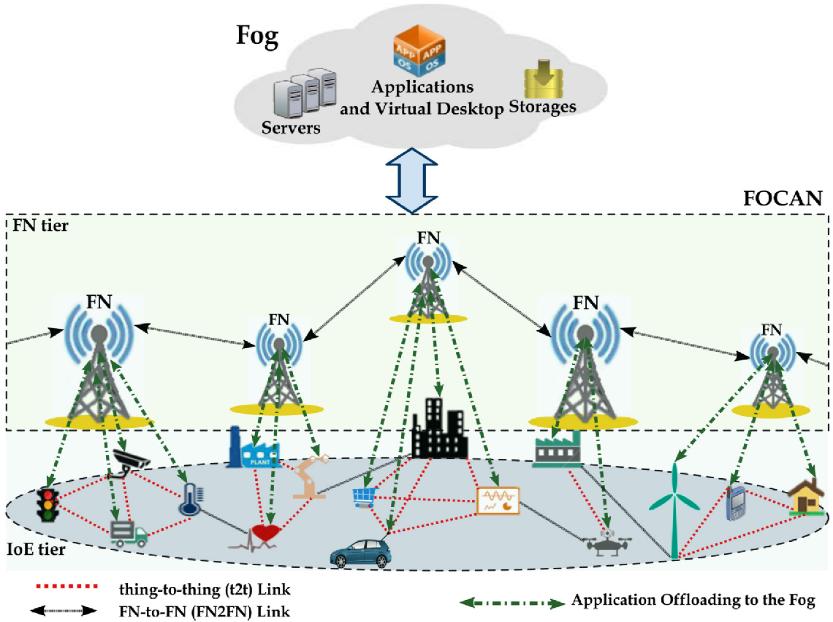
Table 1. Comparison of latency in cloud vs. fog computing.
This table is shown in the PDF version of the article.
2. Background
This section offers an overview of fog computing in smart cities and its significance in bringing facilities to cities. The concepts and descriptions are presented below.
2.1 Fog Computing
The Computer Information System Company (CISCO) introduced the first concept of fog computing in 2012 [3]. Open fog consortium defines fog computing as "a horizontal, system-level architecture that distributes computing, storage, control, and networking functions closer to the user along a cloud-to-thing continuum." "horizontal" refers to the platform that lets computing processes and functions be distributed between various platforms or industries. Furthermore, fog computing supplies a platform that is flexible enough to meet the needs of users and operators [4]. Several exclusive, beneficial attributes of fog are as follows:
2.2 Security
In the light of transmitting data and information in a remarkably short distance along with utilizing the same policy, procedure, and control for fog nodes, security vulnerabilities, and risks decrease, and security monitoring and authentication methods perform as efficiently as possible.
2.3 Latency
Fog environments with widely distributed fog nodes tremendously reduce latency by being close to end devices. Hence, fog computing is axiomatically efficient in time-sensitive and location-sensitive applications.
2.4 Efficiency
The nearer vicinity to end-devices of the endpoints enables fog computing to be more nearly integrated with end-device systems to improve overall performance and efficiency. It is incontrovertibly a prominent characteristic of performance-crucial and cyberphysical systems.
2.5 Cognition
Vast spread fog nodes of fog architecture can best recognize where to perform the storage, control functions, and computing by awareness of user requirements originating from being geographically distributed.
More importantly, three major cloud computing service models, including SaaS (software as a service), PaaS (platform as a service), and IaaS (infrastructure as a service), can also be implemented in the fog environment. The differences between fog and other computing paradigms are elaborated upon hereunder.
I. Delay-sensitive and location-awareness: In a system where a fog node communicates with other fog nodes, fog computing efficiently suggests the lowest delay possible for path and response or analyzes the information much faster than centralized cloud computing. This is because fog nodes know their logical location in the whole network.
II. Real-time response: Fog environment carries out data analytics at the network's edge by which time- and latency-sensitive control functions and applications occur at a dramatically closer distance.
III. Heterogeneity: Different network types have different data processing or collections, and fog computing supports them all.
IV. Federation and interoperability: Supporting multiple services requires varied providers' collaboration.
Therefore, services should be federated all over the amplitude V. Geographical distribution: In contrast to the centralized structure of the cloud, fog computing is geographically distributed VI. Fog nodes agility and scalability in clusters: fog computing at clusters and their levels supports resource integration, elastic computing, network condition changings, and data-load variations that show some adaptive operations.
2.5.1 Fog vs. Edge
Fog computing and edge computing are often mistakenly confused, yet there are prominent differences between them. Running applications in a multitier architecture, fog computing meshes and decouples the software and hardware functions through which dynamic reconfiguration is possible for various applications, even when performing transmission services or intelligent computing. On the other hand, Edge computing supplies transmission service directly by running applications in a fastened location. Indeed, the fog environment is highly hierarchical, while edge computing is frequently restricted to a few endpoint appliances and devices. Furthermore, besides networking and computation, the fog layer addresses data processing, control, and storage acceleration.
2.5.2 Fog architecture
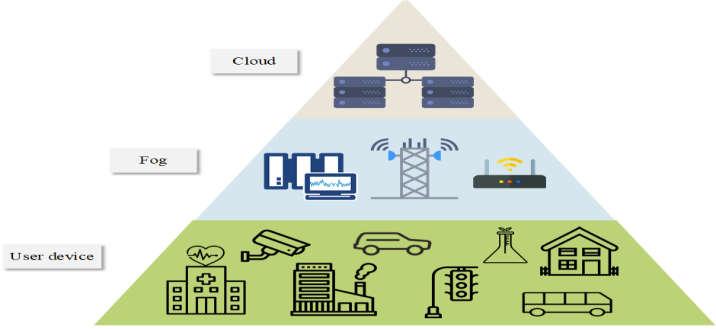
Fog computing is a horizontal multitier architecture that expands the network topology with distributed storage, networking, and control functions. As shown in Fig. 1, fog computing has a three-layered architecture. We have described every layer below:
Cloud layer
In this layer, several centralized storage and computing centers are gathered, which analyze, store, and process data with high performance.
Fog layer
In this layer, many fog nodes are located near the lowest layer, the user device layer. Processing data to increase locality is the fog layer's responsibility. Physical devices such as gateways, routers, virtual machines, and switches are broadly distributed between the end-device and cloud layers.
The user device layer
contains various devices that comfort people's lives. Many cell phones, vehicles, sensors, cameras, etc., exist in this layer to transfer sensed data to the upper layers to be processed and stored. In this three-tiered architecture, every user device or sensor is connected to fog nodes via wireless connections such as Bluetooth, 5G (5th generation), 4G (4th generation), Wi-Fi, ZigBee, or wired technologies. Moreover, fog nodes have the potential to make multiple connections with each other by wired or wireless technologies.
2.5.3 Fog nodes
In sharp contrast to centralized network architectures, the network load adversely rises; fog networking sends the collected information to highly distributed fog nodes where computation, analysis, and storage are performed. In fog structure, virtual or physical components such as virtual machines, switches, servers, gateways, or routers are parts of the core layer. They are responsible for providing information management and communication services or applications between user-device and cloud layers. Fog nodes present the following attributes and characteristics in a fog environment.
I. Heterogeneity: The ability to support and process different forms of data generated by various types of networks.
II. Being manageable: The ability to run regular and routine functions and operations automatically due to being orchestrated and managed by sophisticated systems.
III. Autonomy: Independent operations and local decisions can be performed by fog nodes at every level of nodes or clusters.
IV. Being programmable: The ability to be programmed and developed by domain experts, network developers, users, and providers.
V. Hierarchical structure: Fog nodes and providing various service operations support hierarchical clustering while starting to work together.
2.6 Smart Cities Genesis
The vast areas we know as cities are the living areas for most of the world's population. In the early 20th century, imagining a city handling intelligence technology was like a dream. Still, the computing power and networking grew over time, and humans applied it wisely enough to prove that a smart city is no longer science fiction or a dream. Intelligent communication and information technologies converged and brought an intelligent urban life entirely different from everything.
Table 2. Related researches in fog-based smart cities.
This table is shown in the PDF version of the article.
2017 Cloud-based smart cities Not clear no peresented Not mention 2019 Smart cities challenges Not clear Yes Not Not mention and technologies peresented SLR 2020 Fog-applications in smart Clear Yes peresented 2013-2018 cities - Fog-based approaches in Clear yes peresented 2013-2020 smart cities
We have experienced this until now. Smart cities not only help conventional functions render traffic systems, houses and buildings, and people but also enable analyzing, monitoring, and planning to improve citizens' quality of life. Recent definitions define smart cities as urban agglomerations in which a broad spectrum of IoT devices and sensors are used to collect data and apply them to handle resources effectively. However, cases such as traffic management, real-time manufacturing, self-driving vehicles, fire emergencies, and health monitoring of patients are issues that cannot be solved by smart city equipment alone. Hence, applying security-crucial, location- and time-sensitive approaches of fog computing in the smart city brought favorable outcomes to cities. In a fog-based city supporting IoT applications, multiple services can be enabled to enhance the quality of life. Given smart cities' challenges and issues, the research can be dedicated to exploiting hybrid cloud fog computing, IoT, and mobile device technologies. In particular, transportation services such as intelligent vehicle commutation [5], along with energy efficiency [6], health-care services [7], network types [8], and citizens telecommunications [9], are the domains that can take advantage of fog computing and its benefits.
2.7 Metrics Definition
Different metrics must be compared to evaluate different procedures in fog-based smart cities. These comparisons can help identify these procedures and find their strengths and weaknesses. This paper compares the most prominent metrics of papers reviewed by fog-based smart cities. These metrics are listed below: · I. Scalability: The ability to extend fog-based technologies in services, nodes, and applications. Response time:
The interval between sending a request and receiving a response from a fog node.
II. Security: The activities that prevent damage to data or services and retain the usability of information or technology (hardware, software).
III. Energy: The amount of power utilized in smart city networks.
IV. Cost: What a component or supplicant pays in return for a need.
V. Throughput: The quantity that shows the amount of processed information in a system at a specific time. VI. Latency: The transmit time that a packet needs to spend.
3. Open Issues and Future Trends
This section will discuss the challenges and issues not perused in fog-based smart cities. As a response to RQ6: what are the open issues and future trends of fog-based smart cities? We have proposed the following answers.
Optimal Solutions and Algorithms The optimization algorithms used in smart cities based on fog computing approaches bring lower energy consumption, delay, and convergence for improving cities. However, from the slant of complexity, these algorithms are regarded as a subclass of NP-hard or NP-complete class, such as scheduling and geographic routing. Consequently, there are other meta-heuristic or heuristic methods to reach the optimized solution, such as simulated annealing, particle swarm optimization, gray wolf optimizer, bee colony, bat algorithm, memetic algorithm, genetic algorithm, lion optimizer algorithm, and ant colony. All these solutions are engrossing in future studies.
Big data analytics a massive collection of diverse and complex data that is being unprecedentedly stored and collected is called big data. Big data has caused problems and issues in analysis, storage, processing, and result visualization. The five prominent attributes of big data are variety, volume, value, veracity, and velocity, known as 5Vs. .Hence, any significant data movement from smart devices and equipment to the cloud may not be efficient. Big data analysis is also necessary for getting real-time and optimal responses in smart cities.They need to be processed quickly with the lowest delay possible. Therefore, getting real-time responses depends on finding the closest fog node to communicate with, so fog computing is advantageous. Big data analysis can be essential enough for the future of smart cities Green smart cities and energy consumption given the expansion of smart cities, the variety and scale of services provided in smart cities are one of the challenges facing energy resources. Therefore, services provided in smart cities to reduce energy consumption should be optimized. Fog technology is one of the most appropriate tools to reduce energy consumption. Optimal energy consumption in smart cities is also one of the best ways to reduce greenhouse gas emissions. Therefore, research into creating "green" cities with the least energy consumption is one of the open issues ahead.
Social networks for management and surveillance The inclusion of Online Social Networks (OSN) in villages, cities, and countries has provided an excellent platform for their use in smart cities based on fog computing. Connecting people in cities through social networks has created a large graph. Also, the content transmitted through this vast network generates rich data. OSN can predict how fog resources are distributed in smart cities. It also can predict on-demand services and how to apply for resources. Using the information and data processing created in OSN can create a different experience of smart cities based on social relationships. Social networks such as Instagram, Twitter, and Facebook have created massive networks and data. Therefore, one of the best areas for future work is to use OSN in smart cities based on fog computing. Application Challenges The use cases and applications of fog-based smart cities are designed to be applicable in quite a few fields. In this subsection, we look at a couple of applications that can be captivating for future works.
3.1 Smart Transportation
traffic control and autonomous cars Coupling smart infrastructure with intelligent vehicles proves that a cloud-only scheme is not enough for autonomous transportation, and the fog computing model is needed. The Internet of Vehicles (IoV) emerged from IoT and mobile Internet convergence, where vehicles are intelligent moving nodes in a network. To specify the areas of transportation, we can mention boats or ships, trucks, trains, drones, and buses, which all require traffic control. The systems of controlling traffic receive information from other resources like intelligent traffic lights, cloud-based systems, and municipal systems. Accordingly, the data flow between the fog nodes, vehicles, and traffic control system in any direction should certify that all equipment will have the required control capability. Nevertheless, some points left uninvestigated can be interesting in future works, such as the effect of vehicle velocity on fog nodes' computational functionality. Moreover, researchers did not check if there are any issues or challenges in large cities worldwide.
3.2 Smart Homes
The technology of smart homes is now a trend in current societies that supplies smart environments for living, along with comfort and convenience. Smart homes might have numerous sensors or devices working together, including occupancy, humidity, security, temperature, keycard readers, air quality, and door close/open. There are multitudinous issues for the future of smart homes, which enable them to be more efficient. The issues include energy consumption and carbon footprints, privacy and security, latency, failure management, and fault tolerance. They all can be interesting open trends.
3.3 Smart Health-Care
Health care and patient care are among the most engrossing areas in fog computing-based smart cities. The critical information about people's health and medical status must be transferred without latency and secure and independent . At the same time, high-quality care must be maintained while cost reduction is demanded [7]. Additionally, other issues to research are energy utilization resulting from task offloading, data management, scalability, cost, and interoperability. They all are still open issues and future trends for researchers.
Security and privacy Privacy and security are big challenges in smart cities. Smart sensors and computing nodes should have the security necessary to prevent potential misuse, especially in critical environments. Also, privacy is another challenge for smart cities. Protecting the privacy priorities of service providers and users is essential to maintaining it. Due to the integration of various services in smart cities, providing services to users or providers can be associated with mistakes, such as sending information to people who are not authorized. However, according to our survey, a few papers have adequately tested and evaluated this critical metric. Therefore, one of the significant challenges in fog-based smart cities is assessing security and privacy [10]. Mobility challenges In the case of mobility, many fog nodes and IoT devices could be mobiles, tablets, vehicles, etc. The ubiquity growth of sensor devices is causing a spacious domain of delay-sensitive and large-scale applications [10]. Therefore, if the future location of devices and fog nodes can be predicted in a smart city, it helps to reduce total latency in the fog network and data forwarding. The result of mobility can be seen in fog-based smart cities by recording the pattern of mobility and behavior. Enhancing solutions of smart cities based on fog computing, the semantics of data and contextual information can be extracted. Context-aware and data semantics applications need to know the location of equipment and users and their capability. The location- and context-aware computation in fog-based smart cities is an engrossing area for future research.
4. Conclusion
The rapid urbanization trend has driven the emergence of smart cities, leveraging the power of the IoT to enhance urban services and resident well-being. However, high latency associated with data processing and transmission in traditional cloud-based architectures poses a significant challenge for real-time applications like traffic management, public safety, and environmental monitoring. Fog computing offers a compelling solution by extending cloud computing capabilities to the network edge. By deploying computing resources closer to IoT devices, fog computing facilitates localized data processing, significantly reducing latency. This architecture enables real-time data analysis and faster decision-making, which is crucial for the dynamic demands of smart city environments.
This paper investigated the impact of fog computing on reducing latency in smart city IoT architectures. We analyzed various case studies demonstrating the successful implementation of fog nodes to enhance the performance of latency-sensitive applications. The findings highlighted the potential benefits of integrating fog computing into urban infrastructures, optimizing resource utilization, and enhancing responsiveness. The systematic literature review conducted in this research identified several key areas for future research and development:
I. Optimal solutions and algorithms: Exploring new algorithms and optimization techniques to reduce energy consumption, delay, and convergence in fog-based smart cities.
II. big data analytics: Integrating fog computing with big data analytics capabilities to enable real-time processing and optimal responses.
III. Green smart cities: Optimizing energy consumption in smart cities through fog computing to create sustainable and environmentally friendly urban environments.
IV. Social networks for management and surveillance: Utilizing OSN for resource allocation, on-demand services, and data analysis in smart cities.
V. Application challenges: Investigating specific applications like smart transportation (autonomous vehicles), smart homes, and smart healthcare, addressing latency, security, privacy, and cost concerns.
VI. Security and privacy: Addressing the critical challenges of security and privacy in fog-based smart cities, ensuring protection against potential misuse and upholding user data privacy.
VII. Mobility challenges: Develop solutions to handle mobile fog nodes and devices, predict their location to minimize latency, and leverage context-aware data processing.
By addressing these research areas and leveraging fog computing capabilities, we can create efficient, resilient, and responsive smart cities that provide a high quality of life for their residents. Fog computing offers a transformative approach to managing urban infrastructure and unlocking the full potential of the IoT in smart city development.
Acknowledgments
I want to express my heartfelt gratitude to Dr. Hitesh Mahapatra for his invaluable guidance and support throughout our research on Fog Computing in Smart City IoT Architectures for Latency Reduction. His deep knowledge, constructive feedback, and dedication have been instrumental in shaping the direction and quality of this work. Dr. Mahapatra's mentorship has enhanced my understanding of cutting-edge technologies and encouraged me to think critically and innovatively. I deeply appreciate his encouragement and contributions, which significantly enriched my research experience. Thank you for being an inspiring mentor.
Author Contribution
Amrit Raj was solely responsible for the conception, design, execution, and analysis of the research presented in this paper.
The author conducted all aspects of writing, data collection, and interpretation.
Funding
This research received no external funding.
Data Availability
The data used and analyzed during the current study are available from the corresponding author upon reasonable request.
Conflicts of Interest
The authors declare no conflicts of interest regarding the publication of this paper.
If necessary, these sections should be tailored to reflect the specific details and contributions.
References
- [1] Mohapatra, H., Rath, A. K., & Panda, N. (2022). IoT infrastructure for the accident avoidance: An approach of smart transportation. International journal of information technology, 14(2), 761-768. https://link.springer.com/article/10.1007/s41870-022-00872-6
- [2] Mohapatra, H. (2021). Socio-technical challenges in the implementation of smart city. International conference on innovation and intelligence for informatics, computing, and technologies (3ICT) (pp. 57–62). IEEE. https://doi.org/10.1109/3ICT53449.2021.9581905
- [3] Songhorabadi, M., Rahimi, M., Farid, A. M. M., & Kashani, M. H. (2020). Fog computing approaches in smart cities: a state-of-the-art review. https://doi.org/10.48550/arXiv.2011.14732
- [4] Bonomi, F., Milito, R., Zhu, J., & Addepalli, S. (2012). Fog computing and its role in the internet of things. Proceedings of the first edition of the mcc workshop on mobile cloud computing (pp. 13–16). Association for Computing Machinery. https://doi.org/10.1145/2342509.2342513
- [5] Stojmenovic, I., Wen, Sh., & Huang, Z. H. L. (2014). An overview of fog computing and its security issue. Concurrency and computation: Practice and experience, 28(10), 2991–3005. https://onlinelibrary.wiley.com/doi/abs/10.1002/cpe.3485
- [6] Yousefpour, A., Fung, C., Nguyen, T., Kadiyala, K., Jalali, F., Niakanlahiji, A., … & Jue, J. P. (2019). All one needs to know about fog computing and related edge computing paradigms: A complete survey. Journal of systems architecture, 98, 289–330. https://doi.org/10.1016/j.sysarc.2019.02.009
- [7] Al-Fuqaha, A., Guizani, M., Mohammadi, M., Aledhari, M., & Ayyash, M. (2015). Internet of things: A survey on enabling technologies, protocols, and applications. IEEE communications surveys & tutorials, 17(4), 2347–2376. https://doi.org/10.1109/COMST.2015.2444095
- [8] Khan, W. Z., Rehman, M. H., Zangoti, H. M., Afzal, M. K., Armi, N., & Salah, K. (2020). Industrial internet of things: Recent advances, enabling technologies and open challenges. Computers & electrical engineering, 81, 106522. https://doi.org/10.1016/j.compeleceng.2019.106522
- [9] Stojmenovic, I., & Wen, S. (2014). The fog computing paradigm: Scenarios and security issues. 2014 federated conference on computer science and information systems (pp. 1-8). IEEE. https://doi.org/10.15439/2014F503
- [10] Mahmud, R., Kotagiri, R., & Buyya, R. (2018). Fog computing: A taxonomy, survey and future directions. Internet of everything: Algorithms, methodologies, technologies and perspectives, 103–130. https://doi.org/10.1007/978-981-10-5861-5_5
- [11] Mohapatra, H., & Rath, A. K. (2021). An IoT based efficient multi-objective real-time smart parking system. International journal of sensor networks, 37(4), 219-232. https://doi.org/10.1504/IJSNET.2021.119483
- [12] Mukherjee, M., Shu, L., & Wang, D. (2018). Survey of fog computing: Fundamental, network applications, and research challenges. IEEE communications surveys & tutorials, 20(3), 1826–1857. https://doi.org/10.1109/COMST.2018.2814571