
AI-Driven Edge Computing in Smart City IoT Infrastructures
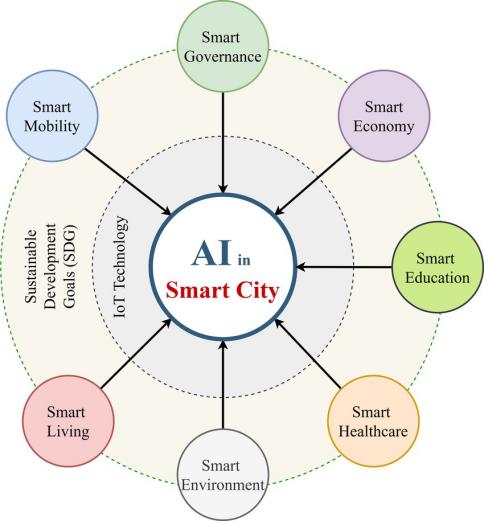
Smart healthcare
AI enables predictive analytics and real-time health monitoring, improving patient outcomes and reducing costs.
Smart environment
AI-driven sensors track air and water quality, helping cities manage resources and reduce pollution [8].
Smart mobility
AI improves traffic systems, reducing congestion and emissions through real-time management [9].
Smart living
AI enhances urban living by automating homes and improving safety and comfort.
2. Background and Related Work
2.1 Smart City IoT Infrastructure
Smart city IoT infrastructures are formed of interconnected sensors, devices, and systems that generate massive amounts of data. These infrastructures support various applications such as traffic management, environmental monitoring, public safety, and energy management. Each application produces and processes data in real time, requiring robust and efficient computing architectures to handle the data load. This section will explore existing IoT frameworks used in smart cities, their limitations, and the need for edge computing.
2.2 Cloud Computing Limitations
Cloud computing has been the traditional approach for handling the large-scale data produced by IoT devices. However, cloud-based architectures face significant challenges in smart city environments due to latency issues, bandwidth limitations, and centralized data processing bottlenecks [10]. These limitations are particularly problematic in scenarios requiring immediate action, such as real-time traffic monitoring and emergency response systems.
2.3 Edge Computing
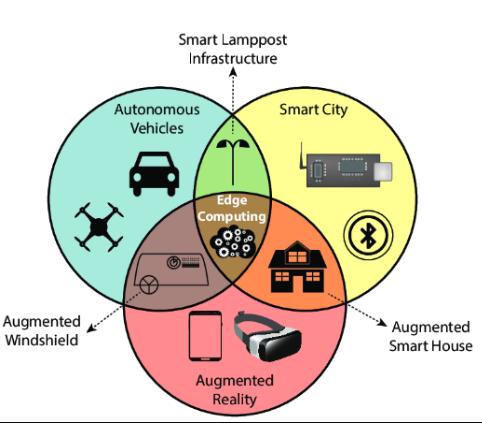
AI-driven edge computing plays a transformative role in smart cities by enabling real-time data processing and decision-making. In smart traffic management, edge computing helps perfect traffic flow by analyzing [11]. Real-time data from sensors and cameras, reducing congestion and improving mobility. Public safety is enhanced through AI-powered surveillance systems that detect threats and suspicious activities in real-time, allowing for quicker law enforcement responses. Environmental monitoring is another vital application, where edge devices track air quality and pollution levels, ensuring sustainable urban living conditions. Additionally, edge computing manages utilities like water and electricity, allowing for efficient resource distribution and anomaly detection. Autonomous transportation also benefits, as self-driving vehicles rely on edge processing for real-time navigation and obstacle detection, improving operational safety. These use cases prove how AI-driven edge computing optimizes city functions, making them safer, more efficient, and more sustainable.
2.4 AI in Edge Computing
Integrating AI techniques like deep learning and Reinforcement Learning (RL) enhances edge computing by enabling devices at the edge to make decisions autonomously. This section will explore the role of AI in enabling real-time analytics, resource optimization, and dynamic task offloading. Federated learning will also be discussed to distribute machine learning model training across edge nodes while keeping data privacy.
3. Proposed AI-Driven Edge Computing Framework
3.1 System Architecture
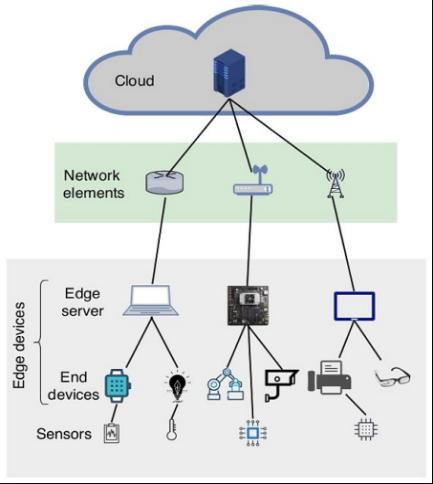
The proposed architecture comprises three main layers: IoT devices, edge nodes, and cloud servers. The IoT devices generate real-time data, which is processed at edge nodes using pre-trained AI models. The edge nodes perform localized decision-making, reducing the need to send raw data to cloud servers. Cloud servers handle long-term storage, large-scale data analysis, and model training, while the edge nodes focus on low-latency processing.
IoT devices layer
IoT devices in smart city environments generate diverse data streams, such as temperature, traffic density, air quality, and energy consumption. These devices are equipped with limited computational power and thus offload data to edge nodes for processing.
Edge layer
Edge nodes are distributed throughout the city and positioned strategically near IoT devices to process data locally. These nodes are equipped with AI algorithms to perform predictive maintenance, anomaly detection, and real-time traffic optimization tasks. By processing data at the edge and minimizing latency, these nodes reduce the overall burden on cloud infrastructures.
Cloud layer
The cloud layer is the central repository for storing historical data and training AI models. Periodically, edge nodes synchronize with the cloud to update their AI models based on new data and improved algorithms.
3.2 AI Algorithms at the Edge
Integrating AI at the edge brings intelligence to decision-making processes, allowing for localized actions in real-time. The following AI algorithms are deployed at edge nodes:
Deep learning
Deep learning models such as Convolutional Neural Networks (CNNs) are used for image and video analytics in applications like smart surveillance and traffic management. These models allow edge nodes to detect objects, recognize patterns, and classify data efficiently.
Reinforcement learning
RL is applied in dynamic decision-making scenarios like traffic signal control and energy management. Through RL, edge nodes continuously learn from the environment and improve their decision-making strategies, enabling adaptive resource management in smart cities.
Federated learning
Federated learning enables multiple edge nodes to collaboratively train AI models without sharing raw data. Each node trains its model locally and shares only model updates with the cloud. This approach enhances privacy and reduces network congestion by keeping data distributed across edge devices.
4. Application Scenarios
4.1 Traffic Management
AI-driven edge computing enables real-time traffic data analysis to perfect signal timings, reduce congestion, and improve vehicle flow. Edge nodes at traffic intersections analyze video feeds and sensor data to make autonomous decisions without relying on cloud servers, reducing delays and improving traffic efficiency.
4.2 Smart Energy Grids
Edge computing balances energy distribution in smart energy grids by predicting demand and perfecting energy allocation. AI models at the edge analyze data from smart meters and renewable energy sources to ensure efficient energy consumption and distribution.
4.3 Environmental Monitoring
Edge nodes equipped with AI models can analyze data from environmental sensors in real time to check air quality, detect pollution levels, and predict weather conditions. Localized data processing ensures prompt alerts and interventions, improving residents' quality of life.
5. Performance Evaluation
Latency reduction
The proposed AI-driven edge computing framework significantly reduces latency compared to traditional cloud-based systems. By processing data closer to the source, edge nodes can deliver real-time responses to critical applications like traffic management and public safety.
Bandwidth efficiency
The architecture reduces bandwidth usage by minimizing the amount of data sent to the cloud, allowing for more scalable and efficient IoT deployments in dense urban environments.
Scalability
The distributed nature of edge computing enhances the scalability of smart city IoT infrastructures. Edge nodes can be deployed in various locations, providing localized processing and decision-making, alleviating the burden on centralized cloud servers.
6. Challenges and Future Directions
Security and privacy
Deploying AI models at the edge introduces potential security vulnerabilities, as edge nodes may be less secure than centralized cloud servers. Techniques like federated learning and encryption can mitigate these risks, but further research is needed to ensure robust security mechanisms.
Resource constraints
Edge nodes have limited computational and storage capacities compared to cloud servers. Efficient AI model compression and optimization techniques are needed to deploy resource-intensive AI algorithms on edge devices.
AI model updates
Maintaining up-to-date AI models across multiple edge nodes is a challenge. Federated learning provides a solution, but frequent updates may still be needed to account for changes in the environment and application requirements.
7. Conclusion
In conclusion, ai-driven edge computing architecture in a smart city is a key enabler of the next generation of urban ecosystems. As cities grow more complex, the demand for real-time, data-driven decision-making becomes paramount. By pushing computational tasks closer to where data is generated, edge computing alleviates the pressure on centralized cloud servers, reducing bandwidth consumption and minimizing delays in communication. This decentralization of processing power allows for smarter, quicker responses to critical urban needs, such as traffic flow optimization, energy management, public safety, and environmental sustainability.
Furthermore, cities can continuously learn and adapt to evolving conditions by integrating AI at the edge. AI algorithms running on edge devices analyze data locally, making real-time predictive and autonomous decisions, whether adjusting street lighting based on foot traffic or managing smart grids to balance energy consumption. This real-time analysis and local decision-making create a highly responsive infrastructure that enhances the quality of life for citizens, improves operational efficiency, and fosters economic growth. Adopting AI-driven edge computing marks a significant shift toward smarter, more efficient cities. It ensures scalability, security, and sustainability, laying the groundwork for resilient urban systems tackling modern challenges. As technology continues to evolve, the synergy between AI and edge computing will be a crucial pillar in shaping the intelligent cities of tomorrow, where everything from transportation to healthcare becomes more interconnected, intelligent, and efficient.
Author Contribution
Ankit Biswas: Conceptualized the study, developed the method, and wrote the original draft for AI-driven edge Computing in Smart City IoT Infrastructures.
Funding
This research received no external funding.
Data Availability
The data supporting this research's findings are derived from publicly available sources, including academic publications, industry reports, and case studies related to AI-driven edge computing and smart city IoT infrastructures. Specific datasets used in the analysis can be accessed through the referenced works and institutional repositories. If further data are needed to verify or replicate this study, interested parties are encouraged to contact the Author directly at 22052533@kiit.ac.in for more information.
Conflicts of Interest
The author declares no conflicts of interest regarding the publication of this paper. The research presented in this paper is based solely on the Author's original findings and insights into integrating AI-driven edge computing in smart city IoT infrastructures. All information has been sourced and presented with academic integrity and ethical standards.
Figures
References
- [1] Mohapatra, H. (2021). Socio-technical challenges in the implementation of smart city. 2021 international conference on innovation and intelligence for informatics, computing, and technologies (3ICT) (pp. 57-62). IEEE. https://ieeexplore.ieee.org/abstract/document/9581905/
- [2] Zanella, A., Bui, N., Castellani, A., Vangelista, L., & Zorzi, M. (2014). Internet of things for smart cities. IEEE internet of things journal, 1(1), 22–32. https://doi.org/10.1109/JIOT.2014.2306328
- [3] Gubbi, J., Buyya, R., Marusic, S., & Palaniswami, M. (2013). Internet of things (IoT): A vision, architectural elements, and future directions. Future generation computer systems, 29(7), 1645–1660. https://doi.org/10.1016/j.future.2013.01.010
- [4] Botta, A., De Donato, W., Persico, V., & Pescapé, A. (2016). Integration of cloud computing and internet of things: A survey. Future generation computer systems, 56, 684–700. https://doi.org/10.1016/j.future.2015.09.021
- [5] Da Xu, L., He, W., & Li, S. (2014). Internet of things in industries: A survey. IEEE transactions on industrial informatics, 10(4), 2233–2243. https://doi.org/10.1109/TII.2014.2300753
- [6] Sun, Y., Song, H., Jara, A. J., & Bie, R. (2016). Internet of things and big data analytics for smart and connected communities. IEEE access, 4, 766–773. https://doi.org/10.1109/ACCESS.2016.2529723
- [7] Shi, W., Cao, J., Zhang, Q., Li, Y., & Xu, L. (2016). Edge computing: Vision and challenges. IEEE internet of things journal, 3(5), 637–646. https://doi.org/10.1109/JIOT.2016.2579198
- [8] Mohapatra, H. A. K. R. (2020). IoT-based smart water. IoT technologies in smart-cities: From sensors to big data, security and trust, 63. https://B2n.ir/d44249
- [9] Alkinani, M. H., Almazroi, A. A., Adhikari, M., & Menon, V. G. (2022). Artificial intelligence-empowered logistic traffic management system using empirical intelligent XGBoost technique in vehicular edge networks. IEEE transactions on intelligent transportation systems, 24(4), 4499–4508. https://doi.org/10.1109/TITS.2022.3145403
- [10] Mammen, P. M. (2021). Federated learning: Opportunities and challenges. https://doi.org/10.48550/arXiv.2101.05428
- [11] Slama, S. B. (2022). Prosumer in smart grids based on intelligent edge computing: A review on Artificial Intelligence Scheduling Techniques. Ain Shams engineering journal, 13(1), 101504. https://doi.org/10.1016/j.asej.2021.05.018