
Cloud-Edge Architecture for IoT in Smart Building Automation
Abstract
Incorporating Internet of Things (IoT) technologies into smart building automation brings forth challenges related to data processing, latency, and security. This study investigates a cloud-edge architecture aimed at mitigating these concerns by improving data management and facilitating real-time decision-making. The approach utilizes a layered methodology comprising IoT devices for gathering data, edge computing nodes for local data processing, and cloud services for comprehensive storage and analysis. Various case studies are analyzed to demonstrate the application of this architecture in different smart building scenarios, showing marked enhancements in energy efficiency, occupant comfort, and reductions in operational costs. The findings reveal that processing data locally at the edge minimizes latency and bandwidth usage while strengthening security protocols. This architecture simplifies building management and establishes a foundation for future advancements in smart building technology. The conclusions for the industry suggest that embracing cloud-edge architectures can result in more sustainable and efficient building environments.
Keywords:Cloud-Edge architectureInternet of thingsSmart buildingsAutomationReal-time processingEnergy efficiency
1. Introduction
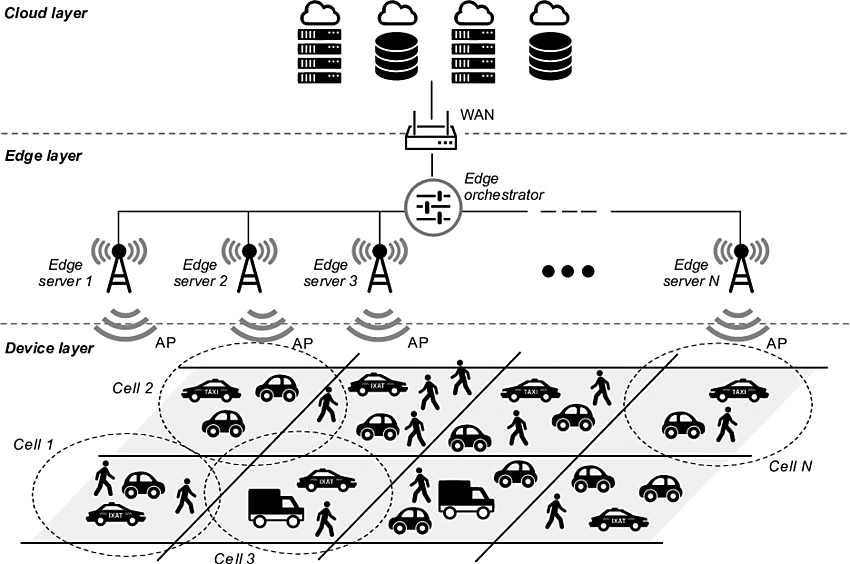
Smart buildings utilize Internet of Things (IoT) devices to monitor and control various systems, including HVAC, lighting, security, and energy management [1]. The cloud-edge architecture enables these functionalities by processing data efficiently and effectively. This architecture comprises three primary layers: 1) IoT devices, 2) edge computing nodes, and 3) cloud services [2], [3].
The integration of cloud-edge architecture in smart building automation not only facilitates efficient resource allocation but also strengthens data privacy by minimizing the transmission of sensitive information to external servers (e.g., Fig. 1) [4]. As we delve deeper into this topic, we will examine the critical components of cloud-edge architecture, its benefits for smart buildings, potential challenges in implementation, and future trends in this rapidly evolving field.
2. Cloud-Edge Architecture Overview
Components of Cloud-Edge architecture
I. IoT devices/sensors: These devices collect data from the environment (e.g., temperature, humidity, occupancy) [5].
II. Edge computing nodes: Positioned near data sources, these nodes preprocess data to reduce latency before transmitting it to the cloud.
III. Cloud services: Provide extensive storage and advanced analytics capabilities for long-term data retention and complex processing tasks [6].
Layered structure
The layered structure of cloud-edge architecture is fundamental to optimizing smart building automation. At the base is the device layer, which includes various sensors and actuators that interact directly with the environment. These devices collect critical data, such as temperature, humidity, and occupancy levels, enabling real-time monitoring and control of building systems. Above this layer is the edge layer, where data is processed locally to minimize latency and reduce bandwidth usage. This local processing allows for immediate responses to changes in environmental conditions, such as adjusting HVAC systems based on occupancy. At the top of this hierarchy is the cloud layer, responsible for handling large-scale data storage and complex analytics. This layer aggregates data from multiple edge devices, enabling advanced analytics and Machine Learning (ML) applications that provide insights into long-term trends and operational efficiencies. (e.g., Table 1) The interplay between these three layers creates a robust framework that enhances building management by facilitating real-time analytics, ensuring resilience during network disruptions, and providing flexibility in deploying tailored solutions. Overall, this layered architecture streamlines operations and supports sustainable practices by optimizing resource use in smart buildings.
Table 1. Layered structure.
This table is shown in the PDF version of the article.
Device layer Contains sensors and actuators interacting with the environment.
Edge layer Processes data locally to minimize latency and bandwidth use.
Cloud layer Handles large-scale data storage and complex analytics.
Integration of Cloud and Edge computing
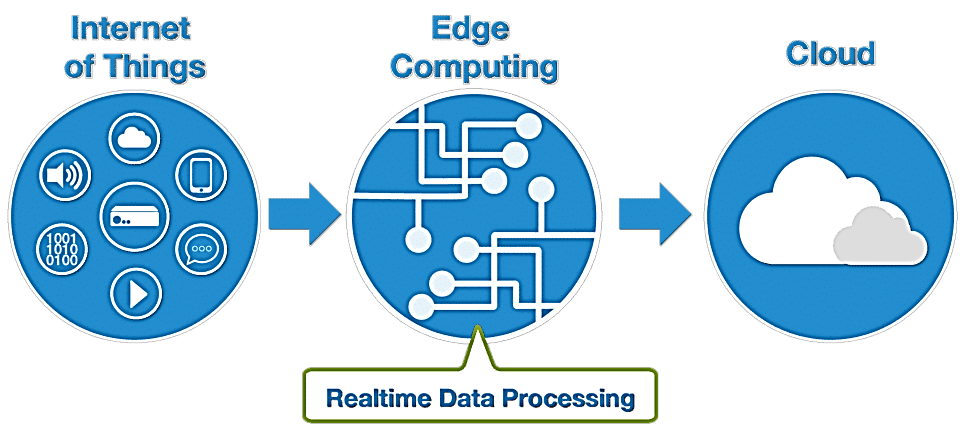
The combination of cloud and edge computing creates a robust framework for IoT applications.
I. Real-time analytics: Edge devices perform immediate data processing while sending aggregated data to the cloud for deeper analysis.
II. Resilience: In cases of network disruption, edge devices can continue operating autonomously, ensuring uninterrupted service.
III. Flexibility: Organizations can deploy edge computing solutions tailored to specific needs while still leveraging the expansive capabilities of cloud computing [6].
Difference between Edge computing and fog computing
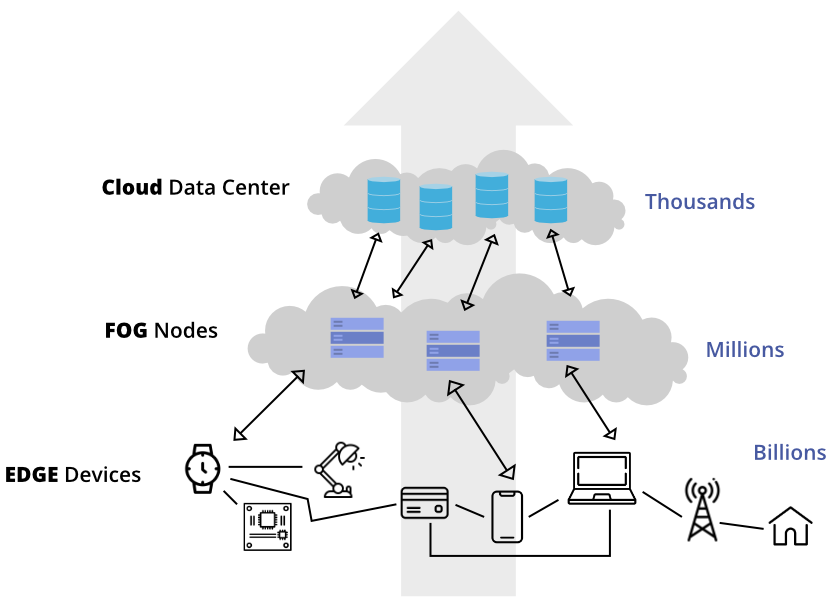
The relationship between cloud, fog nodes, and edge devices in the network hierarchy is integral to the architecture of modern IoT systems, particularly in smart building automation. At the top of this hierarchy lies the cloud, a centralized platform for extensive data storage, advanced analytics, and complex processing tasks. This layer manages large volumes of data collected from various sources and provides powerful computational resources necessary for deep learning and ML applications. Below the cloud, we have fog nodes, which act as intermediaries between the edge devices and the cloud. Fog computing extends cloud capabilities closer to the data source, processing information locally to reduce latency and bandwidth usage. These nodes aggregate and preprocess data before sending it to the cloud, enabling real-time analytics while ensuring critical applications can operate even during network disruptions. At the base of this hierarchy are edge devices, which are situated closest to the data generation points, such as sensors and actuators in smart buildings (e.g., Fig. 3). These devices collect environmental data like temperature, humidity, and occupancy levels, allowing immediate responses to changing conditions. By processing data locally at the edge, these devices minimize latency and enhance efficiency in operations such as HVAC control or security monitoring. The differences between them are shown (e.g., Table 2).
Table 2. Differences between fog and edge computing.
This table is shown in the PDF version of the article.
Location Data is processed at the edge (near devices).
Data processing Primarily local to the device.
Scalability Limited to individual edge devices.
Latency Very low latency due to proximity to the data source.
Fog Computing Data is processed in a distributed manner across a network.
It involves a fog layer that processes data before it reaches the cloud.
It is more scalable due to its distributed nature; it can handle larger networks.
Low latency, but slightly higher than pure edge solutions.
Location Data is processed at the edge (near devices).
Data processing Primarily local to the device.
Scalability Limited to individual edge devices.
Latency Very low latency due to proximity to the data source.
Resource utilization Utilizes local device resources only.
Garamond
Evolution of smart building automation
and environmental challenges24.
Fog Computing Leverages additional resources from fog nodes. Fog computing Data is processed in a distributed manner across a network.
It involves a fog layer that processes data before it reaches the cloud.
It is more scalable due to its distributed nature; it can handle larger networks.
Low latency, but slightly higher than pure edge solutions.
Leverages additional resources from fog nodes.
3. Background and Literature Review
The evolution of smart building automation can be traced back to the late 1800s when the first thermostats were invented. Over the decades, Building Management Systems (BMSs) have transformed significantly. The first generation of smart buildings focused primarily on efficient infrastructure management, while subsequent generations integrated more occupant-centric features driven by advancements in IoT technologies [7].
I. 1st generation: Focused on basic control systems for HVAC and lighting.
II. 2nd generation: Introduced enhanced convenience for occupants through better integration of technology. III. 3rd generation: This generation emphasizes sustainability and health-conscious environments, leveraging IoT platforms and advanced analytics to create agile ecosystems that respond dynamically to user needs
The integration of IoT devices has been pivotal in this evolution, allowing for real-time data collection and analysis. This shift has enabled buildings to transition from traditional management systems to intelligent structures capable of optimizing operations autonomously.
Traditional architectures for internet of things in smart buildings Traditional architectures for IoT in smart buildings typically rely on centralized systems where data from various sensors and devices is collected and processed at a central server or cloud platform [8]. This architecture often includes:
I. Sensors: Collect environmental data (temperature, humidity, occupancy).
II. Gateways: Facilitate communication between sensors and central systems.
III. BMS: Analyze data and control building operations.
While effective, these architectures can lead to bottlenecks due to the heavy reliance on centralized processing. They may struggle with scalability and flexibility as the number of connected devices increases [9].
Task offloading: Local processing vs. cloud processing The decision to offload tasks between local processing at the edge and cloud processing depends on several factors:
I. Local processing: tasks requiring immediate action—such as adjusting lighting based on occupancy or activating security alarms—are best handled at the edge. This minimizes latency and ensures critical systems respond swiftly to environmental changes.
II. Cloud processing: more complex tasks that do not require immediate responses can be offloaded to the cloud. For example, analyzing long-term energy consumption patterns or running ML algorithms for predictive maintenance are better suited for cloud environments where computational resources are more abundant.
Task offloading strategies
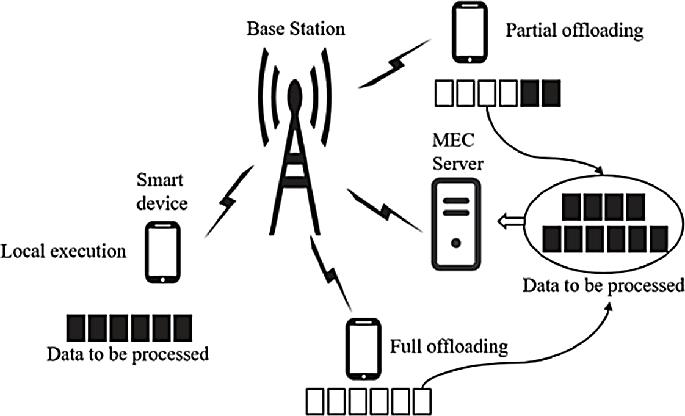
I. Full offloading: The entire task is sent to a remote server. This approach is suitable for tasks that do not require interaction with the local device.
II. Partial offloading: Tasks are divided into subtasks that can be executed partially on the local device and partially on remote servers. This method seeks to balance latency and resource utilization effectively. For example Fig. 4 shows data offloading in Mobile Edge Computing (MEC), where a smart device can perform local execution, partial offloading (some data processed locally, some on the MEC server), or full offloading (all data processed on the MEC server) via a base station.
4. Benefits of Cloud-Edge Architecture
Reduced latency
Processing data at the edge allows for immediate insights without the delays of sending all data to a centralized server. This is crucial for applications requiring real-time responses, such as security systems or HVAC adjustments.
Bandwidth optimization
The architecture minimizes unnecessary data transmission by filtering and aggregating data at the edge before sending it to the cloud, thereby reducing bandwidth costs and enhancing overall network efficiency. This leads to:
I. Reduced bandwidth costs: Less data sent over networks lowers costs.
II. Enhanced network efficiency: More efficient use of available bandwidth, allowing for better performance across all connected devices.
Enhanced security
Data processed at the edge can be secured more effectively as sensitive information does not need to traverse public networks extensively. Edge devices can implement local security measures that complement cloud-based solutions.
5. Implementation Strategies
Choosing suitable IoT devices, communication protocols (e.g., Message Queuing Telemetry Transport (MQTT), CoAP), and cloud platforms (e.g., AWS, Azure) is critical for successful implementation.
Communication protocols
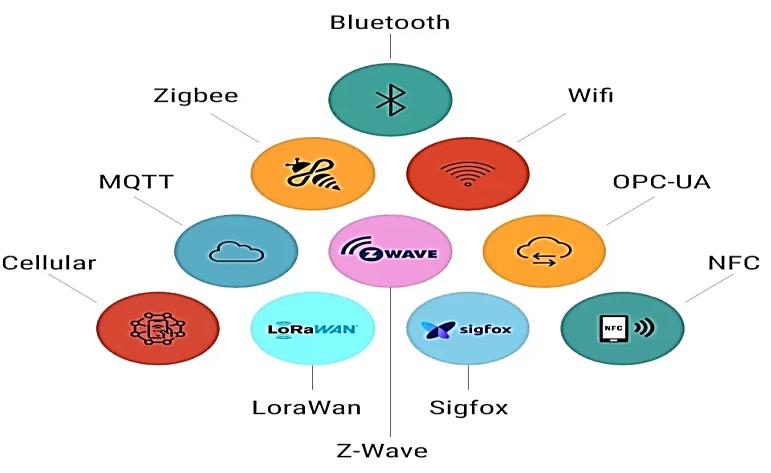
Effective communication between IoT devices is essential for smart building automation. Common protocols include (e.g., Fig. 5):
I. MQTT: A lightweight messaging protocol ideal for low-bandwidth environments. It enables efficient communication between devices and the cloud.
II. ZigBee: A wireless protocol designed for short-range communication. It is commonly used in home automation for its low power consumption and ability to connect multiple devices in a mesh network. III. Bluetooth: Often used for short-range device communication, particularly in mobile applications and personal area networks.
IV. Long Range Wide Area Network (LoRaWAN): suitable for long-range communication with low power requirements, making it ideal for large buildings or campuses.
Data management practices
Implementing effective data management strategies at both edge and cloud levels ensures relevant insights are derived while maintaining system performance. Cloud storage, on the other hand, handles large-scale data for long-term analysis and archiving. Data security, consistency, and synchronization between edge and cloud are critical aspects to ensure data integrity. Additionally, edge data management must be resilient to network disruptions by caching data locally when needed.
Scalability considerations
The architecture must be designed to scale seamlessly as new devices are added or as data volume increases. A hybrid model combining edge computing with cloud resources can achieve this goal. The system should have flexible resource allocation, dynamic load balancing, and distributed data processing capabilities to support scalability. Furthermore, it must allow easy integration of additional devices or sensors without overloading the network or infrastructure. It should support decentralized computing models like fog computing to enhance processing power at the network edge [7].
6. Use Cases in Smart Building Automation
Climate control
IoT sensors monitor indoor climate conditions (temperature, humidity) to optimize HVAC systems dynamically based on occupancy levels. IoT sensors continuously monitor indoor climate conditions, such as temperature and humidity, allowing for the dynamic optimization of HVAC systems based on real-time occupancy levels. This improves comfort and enhances energy efficiency by adjusting heating and cooling in response to actual usage patterns [10].
Predictive maintenance
Real-time data collection from equipment allows for predictive maintenance strategies that anticipate failures before they occur, reducing downtime and maintenance costs. Real-time data collection from equipment enables predictive maintenance strategies that anticipate failures before they occur. By analyzing operational data, building managers can identify signs of wear or malfunction, allowing for timely interventions that reduce downtime and maintenance costs. This shift from reactive to proactive maintenance significantly enhances operational efficiency.
Enhanced security systems
Integrating IoT-enabled security systems allows real-time monitoring and alerts based on occupancy detection and environmental changes. Integrating IoT-enabled security systems allows for comprehensive real-time monitoring and alerts based on occupancy detection and environmental changes. These systems can include smart cameras, access control mechanisms, and alarm systems that work together to enhance the overall security framework of a building. Remote management capabilities enable quick responses to potential threats, improving safety for occupants [4].
7. Challenges and Future Directions
Despite its advantages, challenges such as device interoperability, security vulnerabilities at the edge, and high initial deployment costs persist. Future research should focus on enhancing device standardization and improving security protocols for edge computing environments [11].
Future trends: Artificial intelligence and machine learning at the Edge
The integration of Artificial Intelligence (AI) and ML at the edge is poised to revolutionize cloud-edge architectures.
I. Real-time analytics: AI and ML algorithms can process data locally on edge devices, enabling real-time decision-making without constant communication with the cloud. This capability is particularly beneficial for applications requiring immediate responses, such as autonomous vehicles or smart manufacturing.
II. Predictive maintenance: By analyzing sensor data at the edge, AI can identify patterns indicative of equipment failure before it occurs, allowing for proactive maintenance strategies that minimize downtime and repair costs.
Role of 5G in enhancing Cloud-Edge internet of things architectures
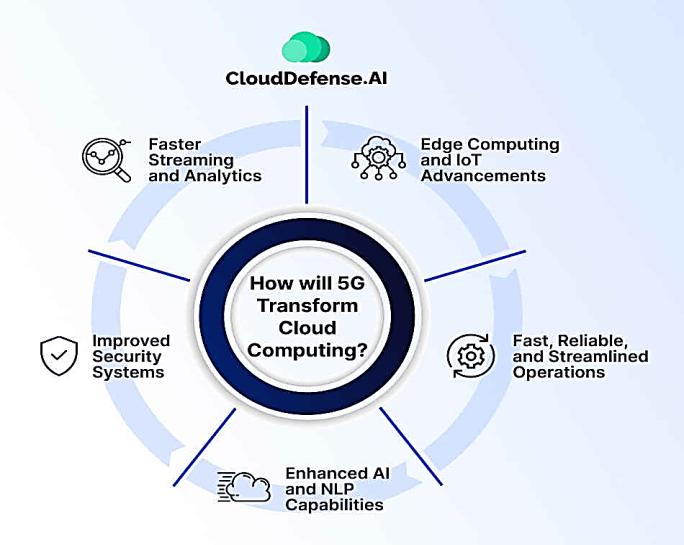
The advent of 5G technology is set to enhance cloud-edge architectures significantly.
I. Increased bandwidth: 5G offers substantially higher bandwidth than previous generations, simultaneously enabling faster data transmission from numerous IoT devices. (e.g., Fig. 6) This improvement is crucial for applications that rely on real-time data processing.
II. Lower latency: With reduced latency capabilities, 5G allows quicker response times in critical applications such as healthcare monitoring and industrial automation. This enhancement supports the seamless operation of cloud-edge systems by minimizing data transfer delays.
III. Enhanced connectivity: 5G networks can support a higher density of connected devices per square kilometer, making deploying large-scale IoT solutions in urban environments and industrial settings feasible.
8. Conclusion
Integrating cloud-edge architecture into smart building automation represents a significant advancement in how buildings are managed, optimized, and experienced by occupants. This conclusion summarizes the key points discussed and reflects on this technology's profound impact on various aspects of building management.
Impact of Cloud-Edge architecture on smart building automation
The impact of cloud-edge architecture on smart building automation is transformative. It enables buildings to become more intelligent and responsive by leveraging real-time data analytics and localized processing capabilities. This shift enhances operational efficiency and supports sustainability goals by optimizing energy usage and reducing waste.
Final thoughts and future outlook
As technology continues to evolve, the future of smart building automation will likely be characterized by even greater integration of advanced technologies such as AI and ML. These advancements will enable more sophisticated predictive analytics, enhancing operational efficiency and user experience.
Moreover, as sustainability becomes an increasingly critical concern globally, the role of smart buildings in reducing carbon footprints will be paramount. The synergy between cloud-edge computing will facilitate innovative solutions that align with environmental goals while meeting the needs of modern occupants. In conclusion, integrating cloud-edge architecture into smart building automation is not merely a technological upgrade; it represents a paradigm shift towards more intelligent, efficient, and user-centric environments. Embracing these advancements will be essential for building managers aiming to create spaces that are functional, sustainable, and conducive to occupant well-being. The future holds promising opportunities for innovation in this domain, paving the way for smarter cities and a more sustainable built environment.
Funding
This research received no external funding.
Data Availability
Data are contained within the article.
Conflicts of Interest
The author declare no conflicts of interest regarding the publication of this paper. If necessary, these sections should be tailored to reflect the specific details and contributions.
References
- [1] Poyyamozhi, M., Murugesan, B., Rajamanickam, N., Shorfuzzaman, M., & Aboelmagd, Y. (2024). IoT—a promising solution to energy management in smart buildings: A systematic review, applications, barriers, and future scope. Buildings, 14(11), 3446. http://dx.doi.org/10.3390/buildings14113446
- [2] Wu, Y. (2020). Cloud-edge orchestration for the internet-of-things: architecture and AI-powered data processing. IEEE internet of things journal, 8(16), 12792 - 12805. http://dx.doi.org/10.1109/JIOT.2020.3014845
- [3] Andriulo, F. C., Fiore, M., Mongiello, M., Traversa, E., & Zizzo, V. (2024). Edge computing and cloud computing for internet of things: A review. Informatics, 11(4), 71. https://doi.org/10.3390/informatics11040071
- [4] Reaño, C., Riera, J. V., Romero, V., Morillo, P., & Casas-Yrurzum, S. (2024). A cloud-edge computing architecture for monitoring protective equipment. Journal of cloud computing, 13, 82. https://doi.org/10.1186/s13677-024-00649-1
- [5] Mohapatra, H., & Rath, A. K. (2023). Designing of fault-tolerant models for wireless sensor network-assisted smart city applications. In intelligent technologies: concepts, applications, and future directions (pp. 25–43). Singapore: Springer Nature Singapore. https://doi.org/10.1007/978-981-99-1482-1_2
- [6] Sinopoli, J. M. (2009). Smart buildings systems for architects, owners and builders. Butterworth-heinemann. https://B2n.ir/wm8362
- [7] Wang, S. (2009). Intelligent buildings and building automation. Routledge. https://doi.org/10.4324/9780203890813
- [8] Jia, M., Komeily, A., Wang, Y., & Srinivasan, R. S. (2019). Adopting internet of things for the development of smart buildings: A review of enabling technologies and applications. Automation in construction, 101, 111–126. https://doi.org/10.1016/j.autcon.2019.01.023
- [9] Casini, M. (2016). Smart buildings: Advanced materials and nanotechnology to improve energy-efficiency and environmental performance. Woodhead Publishing. https://B2n.ir/qz3598
- [10] Mohapatra, H., Debnath, S., Rath, A. K., Landge, P. B., Gayen, S., & Kumar, R. (2020). An efficient energy saving scheme through sorting technique for wireless sensor network. International journal, 8(8), 4278–4286. https://doi.org/10.30534/ijeter/2020/38882020
- [11] George, A. S., George, A. ., & Baskar, T. (2023). Edge computing and the future of cloud computing: A survey of industry perspectives and predictions, 2(2), 19–44. http://dx.doi.org/10.5281/zenodo.8020101